
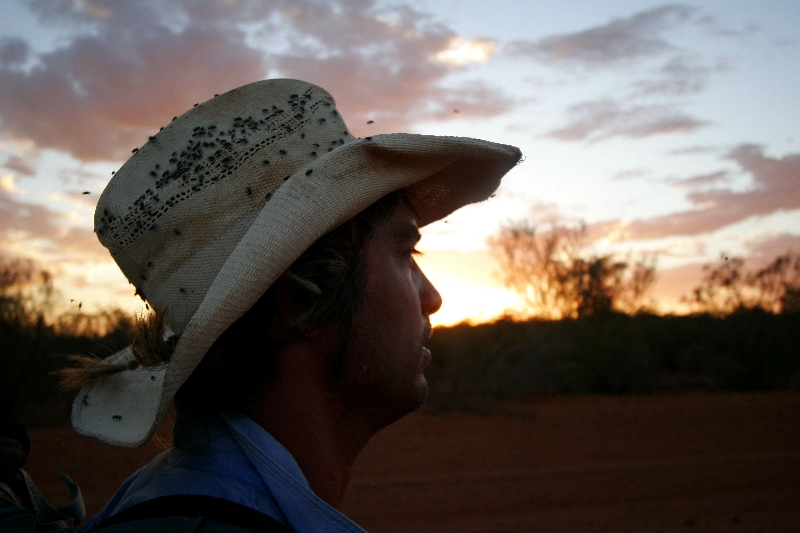
“ Like a journey of a damned soul trudging through purgatory”,
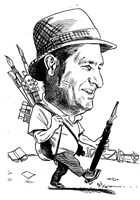
This is what A.G Stephens said of Henry Lawson’s long walk from Hungerford to Bourke in the summer of 1892/93. Lawson himself never kept a journal of the journey, though it influenced much of his writing and commentary at the time. His poetry is littered with references to the walk, and the letters he wrote at the time confirm the bleakness of the experience.
“You can have no ideas of the horrors of the country out here. Men tramp and live like dogs…”
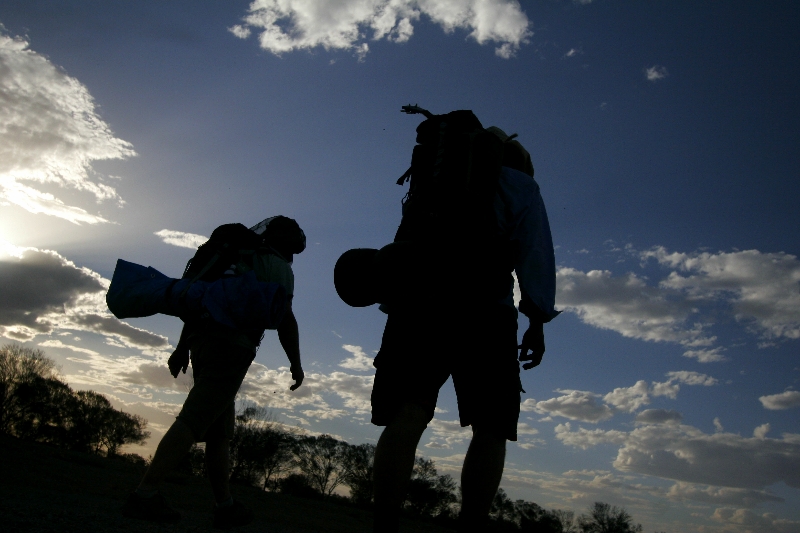
With these words ringing in our ears and the yeast of twenty something beers still gurgling in our stomachs, Ross Lamplugh and myself launched ourselves at Hungerford at around 5.00amon Saturday the 3rd of December, 2005.
We had spent little time in preparation. The previous day I had dropped 15L containers of water every 10 Kilometres for around the first 50 Km of the trip. Ross had been on a spending spree through a metro camping warehouse and we occupied the previous evening loading backpacks and checking out the purchases like kids at Christmas. We carried a change of clothes, couple of changes of underwear, some dried packet food (gourmet camp cuisine), utensils, water, a couple of books, a bed roll and the clothes we had on. We also had a small camp stove and fuel for back up as well as various other sundry items like knives, torches etc. The packs weighed around 25 kilograms and sat well down on our un-toned waists.
Walking through the dawn of that first day we were, as you would expect, full of enthusiasm and we talked non stop. I have always had good, ranging conversations with Ross, and this was no exception as the first 10 Kilometres of the journey rolled by without incident. We had been receiving regular, if not always legible text messages from Tonchi who was driving overnight fromMelbournein a manic state of sleeplessness and road madness. As the first indicators of pain were beginning to set in, he met us at the 15 Kilometre mark and his puppy dog enthusiasm renewed our energy for the trip. Soon after we stopped for a cup of tea, sardines, photographs and laughs, as Browney came past with a ute load of water to ensure we were well provided for along the road.
Lunchtime on day one saw us crossing theGidgeeLakefloodplain, reminiscing about childhood experiences and commenting on the development that was taking place across the plain. Some 15 years earlier I had been one of the first people to work on that country, planting wheat and ploughing the ground, then later surveying, designing and carrying out earthworks to prepare the land for irrigation. Tonchi had grown up not far from there and had spent many days wagging school hiding in the long grass of the floodplain. He still remembers the suck of the earth as he lay on his back, the world spinning beneath and around him, perhaps his first conscious experience with the land.
This lakebed is the last of the high intensity development that surrounds Bourke and thrives off the security of water that theDarling Riverprovides. We have walked through citrus, grape, rockmelom, lime, and various other cropping ventures during the morning. Lawson envisaged this, as he speculated on a landscape that would thrive with irrigation engineering.
Ref “Stranger on the Darling”. A.Barton
Ref “On the Wool Track”. C.W.Bean
Ref “Song of the Darling River” H.L
As the green cotton fields pass behind us, we enter a world of Gidgee forest and low scrub. We are out of reach of the Darling now, and the grey silt of the broad floodplain has become thinly vegetated red sand hills. Kangaroos lie in the gidgee shade, crows watch with interest from the branches and eagles circle overhead.
Somewhere across the 10 Kilometre plain, the walk becomes hard and Ross extends his stride, turns on his mp3 player and leaves Tonch and I well behind. He misses the next water drop hidden in the roadside scrub, and continues on. My stride slows noticeably, so that by the time I get to the water, I can only just make out the figure of Tonch up ahead, Ross is far from sight. I catch Tonch about 5 Kilometres down the road where Ross is resting in some shade and we all agree to push on through to the next water. About halfway across the plain we realise, quite suddenly, that we are all buggered. Our feet are sore and we all walk gingerly, heads down and silent. A couple of cars come along and stop us for a yarn (and a beer), and we realise for the first time that we have set our own standards for the trip, but others have too, and while they expect us to take a beer, they would frown apon us taking a lift. Its hard to describe how difficult it was to get started again, even after a brief stop, and though the water is barely a few Kilometres away, the task seems insurmountable.
The next few Kilometres seem like hundreds, and when we finally reach the Stoney Tank bore. In Lawsons day, he would have walked from bore to bore, probably camping for a day or two at each water supply. This particular stop supported a wine bar and horse yards, where now there is only a hundred years of junk. Old cars, rotting timber, hedges of burr indicate where the dwellings once stood.
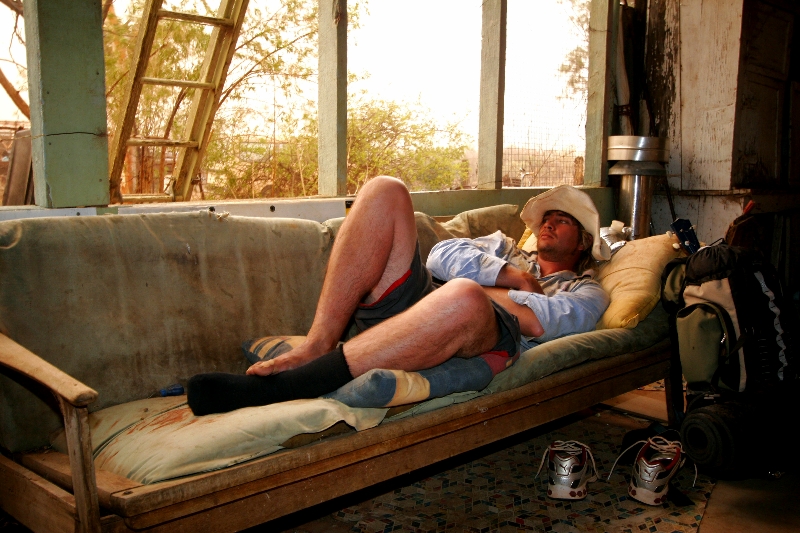
We have our first inkling of the hundred year old bushman experience. On the long hot stretches, the opportunity to rest and drink must have seemed like a winning the lottery. With our feet dragging, we hover on the road with fresh water 500 metres away on the left, but on the right is the possibility of the shady tank…possibly dry. We take the risk and stumble into the tank. The Bore is working, but unkempt and the concrete tank provides no access while the small ground tank offers only muddy pools. There is water there, but the mosquitoes have a found it first, and even on a windymidday, they are on us like fur in seconds. Ross steps in mud and his shoes become 2 kilogram clogs that he has to stump through the dirt on. The mosquitoes deny any rest so we still have to move again and cross the road to the safety of a shallow Gidgee forest, roll out swags, and are instantly asleep.
Ref “Outback” H.L
Ref info on Stoney Tank
Tonch wakes me with a short call as a curious emu has stepped within metres of the camp to check us out. Emus are the most curious of creatures and they will investigate anything new, even to the point of capture. Today it is Ross’s snores that have attracted this one. I lie on my back kicking my legs in the air ,while Tonch waves a red rag, we make stupid, unnatural sounds, knowing full well that even if he is curious enough to investigate further, we don’t have the energy to catch him. He has clearly seen stupid white men before and wanders off in search of something more interesting.
Now I am awake, I realise that we are sleeping in a patch of tiny burr known as ‘Bogan Flea’. Terrible stuff that grows in small clumps, but breaks into thousands of tiny ‘arrow heads’ and sticks to everything. I am thankful for Ross’s ground sheet, which goes at least some way to protecting us. The afternoon sun is beginning to filter through the thin Gidgee leaves cooling the campsite to some extent, and we have a brief opportunity to reflect on the day, and the march ahead, before Mick Bartlett arrives with guitars and beer. I read Lawsons ‘knocked up’ and it makes perfect sense to us, after only one day.
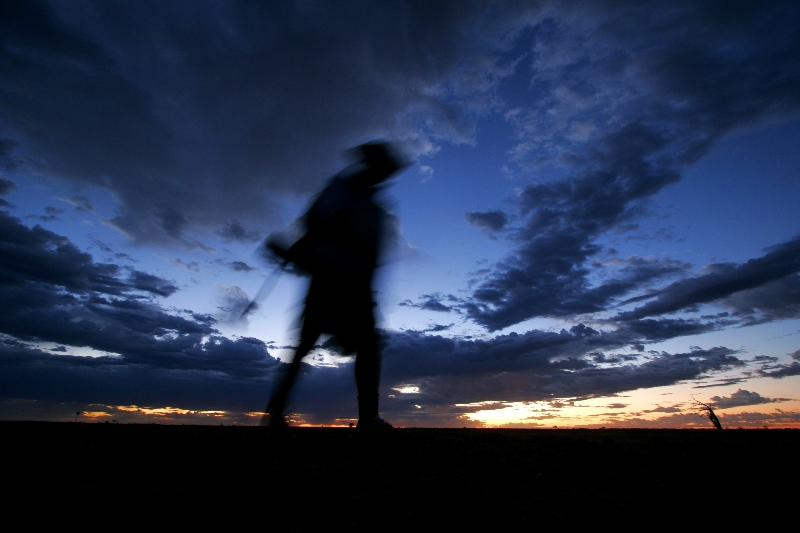
We sleep the wretched sleep of the over-tired and uncomfortable and I’m sure I wake twenty times through the night. Finally at around5amI rise and take some photos in the beautiful half light of the morning. The gidgee trees silhouette the dawn and the viewfinder presents a motionless land, while ears report the true story of the hidden life in the bush’s most active time of day.
Apart from a slight soreness in the legs ,I feel fantastic and set about lighting the fire, organising a cup of tea and packing up.
By the time we leave I am anxious for the road, the sun is low in the sky but still stings and we have about 27 kilometres to go to get to Fords Bridge. Tonch is eager for the aboriginal experience and darts off into the bush to see what artefacts and signs remain. I have walked in the bush with him before and he has taught me much about what to look out for. The country is littered with evidence of occupation. Mosquitoes in the lignum and general discomfort return him to the road a few kilometres later. By the time we stop atLauredaleLake, we are buggered. Tonch and Ross find the water and attend to their worsening feet while I find some shade in an old creek-bed and get some welcome rest.
When we start again it is with Ross in a foul mood, marching well ahead of us while Tonch and I enjoy the time to talk about the bush and life. Another 10Km to the next water drop and Ross has been siting there for some time by the time we get there, he loads up as we arrive and reports that he is not game to remove his shoes and so will push on. The sun is well up in the sky and we follow him after a short stop. It is against our plan to travel so much in one stretch. 10 Kms and then a good rest is the goal we have set, however we are already broken that rule and are stretching ourselves in the 40 degree heat.
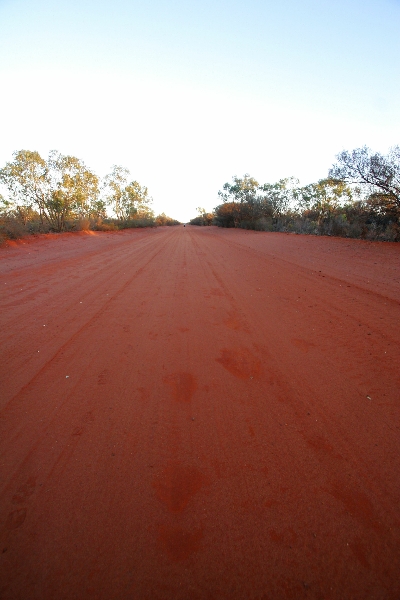
The next stretch takes us past Kelly’sCampBoreand also past a number of pain and psychological barriers. Ross is a speck on the horizon and the only thing we see of him are the wavering footprints in the red sand. The childhood redsandmulgaandgidgee smell is overpowering in this area. It reminds me of my father. The sand hills are relentless and endless and we are sure that we have covered twenty extra Kilometres when we come across a signpost indicating that Fords Bridge is still 9 Kilometres away, we nearly die.
Tonch strides out and a couple of kilometres and I decide to rest. We are all separated, not lost but not sure where we are, and all going through our own personal coping mechanisms. Tired and sore, hot and bothered, uncertain and alone, day two increases the slope of the learning curve.
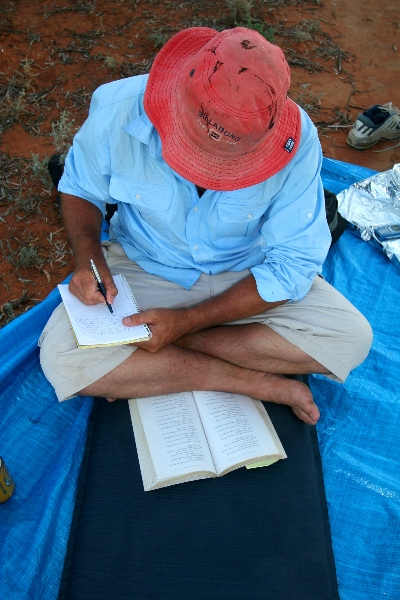
I rest on the ‘windrow’ beneath some acceptable box-tree shade. I am asleep before I realise it and when I wake to a four-wheel drive, I am surprised how rested I am, so I stay and read a little of Lawsons words from ‘Stranger on the Darling’. His description of men waiting in a shearing quarters in ‘stragglers’ is funny, terrible and frightening as it describes much of the experience that we have engaged in. Why didn’t I read this before I came? The reading is of much more interest to me now so I read an walk and it proves to be a worthwhile exercise as the sandhills roll away beneath my feet and I am presented with the Warrego floodplain before me.FordsBridgemust be just a few hundred metres away.
John and Maree Stephenson stop and take a picture as I come off the last of the Sandhill, they are on their way to care-take ‘waroo’ for the Dunk family. Eager to assist, John gives me a cold beer and I set off on the last stretch before the relief of the pub. This walk is heartbreaking ,and I suddenly learn that we are travelling slowly and the floodplain is a good 3 kilometres across. I almost stop at the river but don’t believe I would be able to start again. With a very limited number of steps remaining in the tank I fall into the Pub.
Ross has showered and relaxes on the lounge, Karen is behind the bar and a couple of locals are drinking. Their rough appraisal of me is probably very accurate as I look and feel a mess. I am ready to stop and consider raising the subject with Ross but think better of it. Melissa and the kids arrive and their love revives me more than a beer could. Melissa looks at me with a distant appraisal and I know she is wondering why I am doing it. When I tell her how horrible it is she says “but you’re not going to stop are you?” it’s a reminder to me that I am not the only one with anything invested in this. It is a small and questionable accomplishment, but still something that I set out to achieve, and anything less will be failure. She is thoughtful enough to bring a large drink cooler with ice, electrolytes and melons inside, and is even kind enough to drop it 27km down the road for us. we will make it a target for the morning.
Karen seems totally disinterested behind the bar and I remind myself that we are only two days into the trip and as yet have achieved nothing. Ross cooks dinner, pasta and steak for dinner and we eat like starving dogs. He takes a room at the pub while Tonch and I sleep in the outside hall.
It is another night of sixty ‘5 minute’ sleeps before Ross stirs us at 5am and we begin the days march. Fresh with the terrible experience of yesterday we agree to a set plan of walking. 10Km to the first water, a short break there and then 10 more Kms to the “South Kerribree” mailbox where the next water is. From there it is just a brief dash of 7 Kms to the Nellyvale mailbox where the cache of ice and melons are.
After a slow start in the darkness we make good time to the first water and are relatively ‘together’. We barely stop and decide to make hay while the sun doesn’t shine. Tonch pulls out a small radio and we hear a news report about us on the abc local news. It reminds us of the world behind us and gives us a brief burst of energy and Ross and I talk while Tonch walks ahead. This is all relatively new territory for me as I often go toFordsBridge, but rarely further and I take notice of the sprawling dry lakes and wildlife in the picturesque morning colour scheme. The mornings are truly beautiful out here. Cool and soft with an amazing backdrop which slowly bleaches out, the space on the land becomes more apparent and then the sun is up. The colour departs as the contrast increases. Life disappears into the shade and you are alone on the road again.
South Kerribreeis almost too far and we fall into the hard shade and rest against our packs. We were stopped a little way back by a shooter and after a 2 minute yarn we were almost unable to continue. tonch and I reassured and supported each other for the last 2 Km as we are both in terrible pain. Ross is well ahead. Tonch relates the tale of seeing a walker on the side of the road and stopping to see if he was OK. “He didn’t even look sideways or acknowledge me” he says “just kept walking”. We can all relate to this tale. Stopping is a real burden.
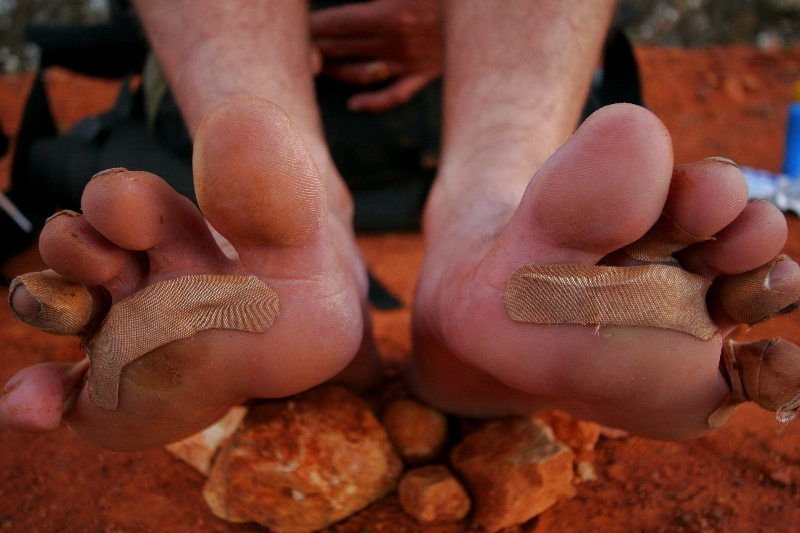
both Ross and Tonch describe the pain of burst blisters as being like knives plunging into your feet and I thank my stars that my feet are relatively good, though they are cooked and sore, there are just a couple of small blisters.
The last stretch to Nellyvale sees Ross with a downturned mouth and grim determination as he sets the pace and walks ahead. This time Tonch and I make every effort to keep up and we stay within a reasonable distance of him. The last & Km feel like seventy and we fall upon the mailbox where the water is. Ross is doggedly trying to rig up some shade on the desolate plain. Small clumps of dying turpentine provide the only shade which is sinister in its thinness. We convince him to do 50metres more and cross the road to where the shade is marginally better. The power-ade, melons and ice water are better than can be desribed and we soon have the groundsheet rolled out and are huddled against themiddaysun. I soon move around and rig a blanket in the trees, rolling out my mattress on the dirt. It is a turning point for me. I have stopped to live with any degree of decorum and the dirt will become my mattress for the rest of the journey.
After a time Phillip Hams comes along and delivers some beers. He is so proud of this experience and I am now ‘Son in Law’ instead of ‘Andrew’. I think this sort of nugatory work resonates well with him. The boys discover that they are in the sun and move their camp around to my side. We rig up better shade and they dress their feet, which are horrible. The pain Tonch felt before was a toe-nail tearing itself off. Melissa has sent out some quality dressings and the boys do the best they can with them, though I fear they are in bad shape.
As a couple of degrees wash off the sun, we set off again for the Youngerina creek which should be about 11Kms away. It is a hard slow walk as we all realise how bad our predicament is. We stick together though, and the experience is a good one as we walk into the night. The creek proves to be further away than we had anticipated and the last few kilometres again find us questioning our ability to continue. We fall upon the water, roll out the sheet and are asleep without food or talk, with the terrible prospect of waking an walking all that we have to look forward to.
Thirty ‘5 minute’ sleeps later I switch on the small radio to learn that it is 4.30 so I rouse the boys and we repack ourselves for the morning march. We head off at a crawl as our muscles and feet scream in protest. Tonch stomps them harder until they give up the argument, I slowly let them warm up and the pain fatigue. It is now that we turn to see that Ross is a good 300metres behind us ,we can see his light. We wait and he watch as he finally gets his pace and walks straight past us. I can imagine his face. After a while he slows and walks with us and he makes the first noises of stopping. I believe it is his only option though I am sure his personality will not allow him to quit and I tell him as much. He walks alone for the next 5Km and when we reach the water he announces that he is withdrawing.
It’s a strange time. He thinks we don’t believe him, but its not that. We don’t know what to say. Sorry? Goodonya? Bad luck? It is really awkward. He takes of his shoes to dress his feet and we busy ourselves boiling the billy for a cup of tea. Finally we speak about it. He says he has learned something out here ,not sure what it is, but something. He hasn’t been home for some weeks and is beating himself up about being out here, challenging himself, killing himself, while his wife and kids are missing him at home. He is genuinely disappointed in himself. Not for stopping, but for being there in the first place. I know him as well as anyone and I have never seen him so introspective. So resolved. This country does that to you, makes you resolute. Decisions have a finality about them.
We make tea and cook up some food, though we have to force it down. We are eating to get rid of the food rather than feed ourselves. There is no hunger even though we didn’t eat at all the previous day. There is only thirst and pain.
Tonch takes off his shoes to dress them and realises that the pain he thought was a burst blister was actually his toenail coming off. It looks infected and I make the suggestion that he should stop, Has to stop. It’s out before I know what it means, because if he stops, I will stop, and its all over. It is also then that I realise that I am ,when a decision has to be made, the leader.
“If you say it’s over. If you say we have to stop, then it’s over and I’ll stop” Tonch says, without looking up.
“just don’t say it”.
II just learnt another thing. For that 10 seconds that there was a chance we were stopping, I was giving up. Taking a soft option. Exploiting a loophole. That’s the person who started the walk. The bloke who would have stopped atFordsBridge, if someone else had mentioned it. Would have finished the whole thing when there was enough injuries to withdraw. Would have jumped in a car and returned home without ever finding even what Ross had already found, let alone anything more. I realised I wasn’t looking, wasn’t trying, wasn’t Anything. Just nothing. There would be no soft options from here on in.
No sooner had we re-distributed the supplies and re-packed the bags than Mark Hams (brother in law) turned up. He was working at commeroo and so had been keeping an eye out for us. He had a big bag of lollies for each of us and a bottle of splashe. Ross jumped in with him and we continued on our way. Very slowly at first, and then falling into a rhythm which had proven to cover around 4Km per hour. We passed the Yandallilla (?) government watering point at around11amand continued up the road. The next water was dropped around 10 Km away in the rough proximity of LakeEliza, and beyond that lay Yantabulla.
The day got markedly hotter and around 7Km along the way, we rounded a slight bend to discover a small oasis beside the road. There was shady trees, water birds and a broad stretch of water banked up against a fence of gidgee posts side by side creating something of a dam. We went in, but were too wary of Tonch’s infected feet to attempt swimming and also cautious of making our shoes heavy with mud. We did get our head and shoulders wet and cooled down for a short time before reluctantly taking the road again. It was the sort of place where we should have camped, but on this trip, the real estate ahead was unknown to us, and our campsites were determined by distance only.
We were only Ikm beyond the oasis when David Fisher stopped with cold water and fruit. He was heading into town and had been keeping an eye out for us. The water and oranges lasted only seconds and david informed us that the oasis we had seen was known locally as ‘The Oyster Farm’. When he left, we had hardly time to get back into rhythm when a caravan stopped with a couple of travellers returning fromCurrawinyaNational Park. When the man heard what we were up to he drew a couple of cold cokes from the fridge in the back and sent us on our way. It may have been the luckiest day of the trip for us so far, but the road would have it’s way in the end.
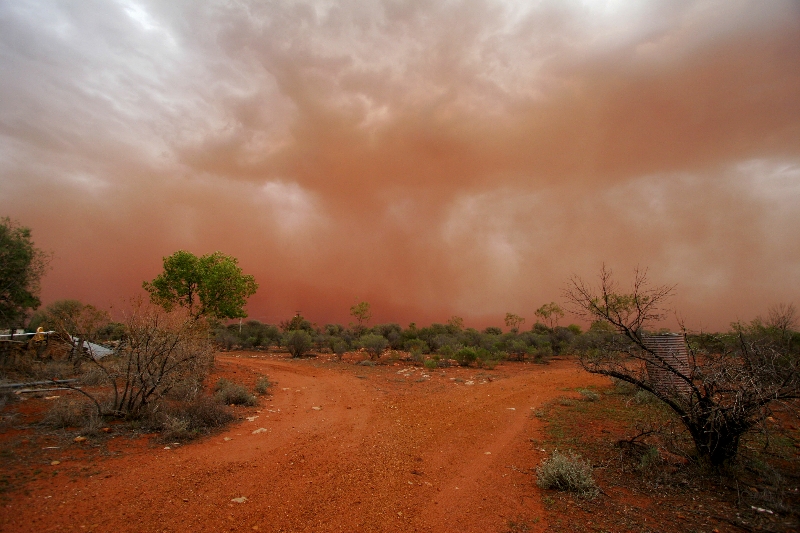
Coming on the water by aboutmiddaywe found some meagre shade on the Eastern wind-row and tried to relax. It was by far the hottest day, (around 45 degrees) and the shade did nothing to cool us. we wrapped a wet towel around the water to try and cool it. Soon after Ross and Mark came back along the road, informing us that they had distributed water all the way to Hungerford. The problem was that they had to increase the intervals to 15Km in order to make the water last. As they left, a hot dry wind began blowing from the North along the sand filled road. picking up dust and sand as it blew, it stung our faces as we tried to sleep. Huddled on the only roadside shade, we pulled our hats down and collars up and turned our backs to the wind. The flies found us to be great shelter though their presence was not even noticed with the howling wind around us.
Occasionally on of us would yell “Is that it?” “That all you’ve got” at the road or the wind or both ,then we’d laugh like madmen and try to sleep. After a while we gave up and dug our way out of the mini sand dunes we had created to continue on our way, into the face of the wind. Now we are yelling “Nothing” and laughing as we lean our bodies against the onslaught.
It becomes impossible to determine how fast we are travelling ,and though we are sure that Yantabulla is just 7 Kilometres away, it seems to take hours. The sun has joined in the battle and beats directly on to our foreheads as we pull our hats down against the wind. When we reach a small bend we are sure Yantabulla must be around the corner, but it cannot be seen. Tonch stops. He looks bad ,panting like a beast and eyes rolling back. I hose him down with my blood-warm water and it cools him as the wind dries it. We must move and after a few hundred metres I can see the town. less than a Kilometre away. At the same time, we notice a windmill on the left 500 Metres off.
“will we risk it?” I say, knowing that if it’s dry ,we have burnt a lot of fuel that we don’t have.
“I’m there” says Tonch though he follows so slowly that I enter the bore paddock alone.
It is like a bovine graveyard. Bones are everywhere. the remains of perished cattle. The ugly low vegetation around is new to me, Galvanised Burr I later find out. It does not look like a place of salvation, quite the opposite, but when I get to the bore ,the concrete tank is full of clear, greenish water. I strip off and submerse myself in it. Stirring up the algae and water bugs I know will be there. It saves me. I have never felt so happy to be wet in my life. Around the storm is raging, but the tank offers a little shelter as well as the salvation of water. Tonch arrives and does the same.
After about 10 minutes in the water we withdraw and out our dusty clothes back on. The water is good, but we will try our luck in Yantabulla to see if we can get some rainwater. walking out of that paddock was one of the most surreal experiences I have ever had. White bones are everywhere, hundreds of them. The sun is just a silver disc behind the dust cloud and wind. The Burr is like something from a spaghetti Western, and as we enter the remains of the township, it is like walking through a modern ghost town. Corrugated iron flaps against the walls of the town hall. Children’s play equipment, broken and unused in the park. The remnants of various dwellings around ‘town’ but difficult to ascertain what is occupied and what isn’t. even the relatively recent looking demountable dwellings appear abandoned and decrepit.
We are wary of talking to Keith and Nora Roberts, the owners of the Yantabulla property. Not for any specific reason, more the fact that we haven’t really been given any advice. If we said to someone that we were stopping at Yantabulla, they would look over your shoulder and say “Oh, OK” in a distant voice, but nothing more. We don’t know if we will be welcomed with good grace, disinterest or hostility. We do know that we need water and rest though , and so make our way to what isn’t the least tumble-down dwelling, but it is the place where the recent car tracks lead to.
“Hello…”
“Anybody there…” we call from the gate, uncertain of dogs, shotguns or protocols.
After a minute Keith comes out to see what we want. Still uncertain about our welcome, we introduce ourselves and ask if we can refill our water bags. He lets us in through a precarious screen door and points to the rainwater tank which is on the other side of the house. I fill the bags and return to Keith, standing awkwardly in the cluttered breezeway.
“We’ll just go and find a spot to rest up the road a bit. How far are the bridges?”
“About 6K’s”
Then, as if on cue, the tin and unfastened material around the house begins to flap in earnest as the dust-storm increases intensity. Keith takes a seat on the step ,his three dogs gather around him and we drop our packs for a bit of a yarn. Before long, we have found comfortable seats in the breezeway and are deeply engaged in conversation.
Keith talks a lot. He has lived and worked in the are for all his life and has plenty to relate about the area, the changes and the future. We speak about the terrible drought, the alignment of the planets, the history of the region. He tells us of the bullock teams that he has seen, and was maybe the last to see in the area. How when they unharnessed the beasts, they would still walk around in perfect formation. The drivers would dig the bore-drains by doing huge cycles and coming in at exactly the right spot to take another ‘bite’ of dirt. This cycle would repeat for miles. Keith may have the best surviving memory of the old days, though it is still memory.
If his memory is in the same shape as his house, it can only just be relied on. The roof flaps in the wind as the storm rages around us and I make a couple of calls in the sweltering office, which used to be the old jailhouse. The dining room and kitchen are rough and unkempt, but the place is not unpleasant. It has the sort of ‘face value’ honesty that you can expect from Keith.
Keith tells us about Yantabulla in the old days. The huge dances in the hall with children playing in the park. The regular community events that would see people travelling in from miles around. The township itself as a centre of commerce with telegraph, post office, horse change station for Cobb & Co and of course, hotels. There was even a lemonade factory, which serviced the hotel and the town.
Tonch looks ill and I engage Keith in reminiscing as Tonch reclines on the lounge. Before long, the storm explodes into a sudden downpour, which rattles off the roof and blows in through the rough screen of the breeze-way. It doesn’t last long and the result of it is a relatively cool change and settled dust. For the next ten minutes, Keith receives phone calls from neighbours talking and warning about the storm, so we try to close our eyes and gain what rest we can.
After about an hour of the most informative conversation we need to leave and so reluctantly say goodbye to Keith and resume the march.
A few kilometres up the road we are met by Phillip Hams and Sharpey from Commeroo. They had finnished work for the day and bought us over some food beer and cold water. We sit and have a yarn at the roadside for about an hour and Phillip tells us that Keith has hardly spoken to anyone for many years. He reckons we were lucky to even be allowed inside.
After a good yarn, Phillip and Sharpey agree to leave some cold water at the end of the bridges some 5 Kilometres away and we wave them goodbye and begin marching again. It has been the strangest day with visitors, storms, ghost towns and history and we still have a few kilometres to walk.
We cross the Cuttaburra at bridges number 1 and 2 and miss the cold water in the darkness. It is at least 12 kilometres to the next water drop, so we try to make a good part of it in the cool of the night. With one eye on the clouds and lightning we put another 7 kilometres behind us before dropping to the ground on the roadside, digging a hip-hole and sleeping.
As with the previous morning, we rise around4am, pack quickly and leave. Eager to reach the shelter of Brindingabba before the weather turns bad on us again.
At about7amwe reach the Kia Ora mailbox where the water is and make a small fire on the roadside to fix ourselves a cup of tea. Later we find out that Tony Marsh, the manager ,spent much of the previous day waiting for us at the mailbox. He wanted to take us in to the artesian bore for a soak in the hot mineral water, and it would have been most welcome. it signifies much of the second part of the journey. More and more people are eager to assist and be involved. The network is strong between the property owners and we are in their local area now so they are looking after us.
Joe the mailman comes by as we are packing up and we see him exchange the mailbags in the large roadside box, an activity he does twice weekly. He checks us out as Tonch dresses his feet and drives off shaking hi head.
We had organised to call in at Brindingabba, which is still another 15 kilometres away so we reload our water bags with an extra few litres and begin the march. It is the worst part of the journey yet for me as I struggle to find a rhythm. My sore feet have meant that I have changed the way I am walking and I am stumping along rather than rolling my feet. We walk to what we think is the 7Km mark and I fall to the wind-row in the shade and sleep.
We wake to see Kylie Fisher driving past and decide to continue before the heat kills us. I cannot believe how hard it is to walk and I train my reluctant feet to roll and not stomp. Kylie and her car-load of kids stop on the return trip and tell us that they will be decorating the mailbox for Christmas will meet us there, about 3 km away. It might have been another 30Km by the time I get there and they have to urge me to take the last few steps. I want to die.
We load the packs into the car, climb in and suddenly realise how rotten we are. At least a hundred flies are so attached to us they from an instant black cloud inside the car.
“I bet you boys are looking forward to jumping in the pool” says Kylie. “and not just because you stink…”
She takes us to the old Brindingabba homestead which she is renovating and puts us in one of the rooms. A building in the old style with foot-thick rammed earth, or ‘Pise’ walls, wide verandahs and tall ceilings.
“I’ll leave you to do your thing, and then come over and have a swim”.
There are beds. Un-made, dusty, old, beautiful beds! We fall on them, rotten as we are, and the only word I can say is “terrible”, over and over until I fall to sleep.
It is probably only the brief sleep that we have become used to, but we are more refreshed when we wake and make our way to the pool. It is divine to be wet and relatively clean and we even manage to frolic when Kylie takes our photo. She also takes our clothes and washes them and invites us inside for lunch.
It’s hard to describe how alien a normal, modern house, full of family life, feels. Yesterday at Keith’s did not seem strange in its decay, it seemed appropriate, but this home with children, clean surfaces and things in their place seems odd and unfamiliar. We play with the children, they’re father is still away and they relish the male company. We smell lunch cooking, luxuriate in the air-conditioning and drink coffee as Kylie tells us of her experiences and plans at the historic property.
Not long before lunch we are joined by a couple of travelling missionaries from an outreach centre based on theSunshineCoast. They had passed us earlier on the road and so knew what we were all about. By the time they got there we were cleaned and caffeined and so ready for a yarn. They were travelling the bush, mostly South Western Queensland, delivering drought relief hampers and offering ministry to the remote properties. They seemed both zealous and dim, though harmless, and after lunch we left them to pray for Kylie as we tried to get some sleep.
In the old Brindingabba homestead the air conditioner rattled through our fitfull sleep and I was sure that there must have been another howling wind outside, but after rising I discovered that it was relatively mild and there had been another settling afternoon shower.
Kylie had washed and dried our clothes and cooked a hearty pasta meal so we had another opportunity to chat and re-fuel. We learnt that we were just 7Km from theQueenslandborder, though Hungerford was still over 50 Kilometres away. We planned to make 10 more Kilometres that night, and 20 in the morning which would leave us a short 10 k’s the following night and a leisurely 10 k’s into Hungerford on Friday morning. Though as Kylie returned us to the road, both of us knew that we would push ourselves to get there by Thursday afternoon.
The early pert of the evening was a walk in fairly numb silence. We had just glimpsed a part of the reality that had seemed so far behind us. In fact, we were probably more comfortable to be back on the road. We walked into the night for a good stretch, crossing Brindingabba creek and heading down onto the Waroo plain.
The Waroo plain is an obstacle that we were aware and wary of. We had a range of estimates as to its width, somewhere between 8 and 15 kilometres. We did not want to strike it in the middle of the day, for though the walking would be no different in theory, it would break our spirits to feel stranded in such geography. With this in mind, we marched strongly onto the plain and noticed the silhouette changing in the scarce moonlight until there was no tree-line, but just a vast stretch of emptiness in the dark.
The next water drop was roughly 3 Kilometres into the plain and when we struck it we were exhausted. Already the water being 15Km apart instead of 10 was taking its toll. We rested on our packs with the determination of walking again soon, but fell asleep and re-positioned ourselves horizontally. We did not roll out our bed-rolls. Another night of fitful sleep meant that I was constantly trying to guess the time. The little transistor radio that Tonch had brought eventually picked up a radio stations and I listened to Luck Oceans play Neil young songs for a few minutes before rising. I guessed it must be around3amand wanted to cover the plain in the dark.
As I rose, I heard gunfire and saw the spotlight of a shooter working nearby. I ran out to the road and switched on the halogen light Ross had left behind. The blue light must have looked distinctive in the dark as the shooter flashed me and drove up to us. It was Terry (Boom Boom) Bates, who had passed us earlier in the trip and dropped out some band-aids. He pulled up the shooting wagon and had a yarn for about half an hour, informing us that it was only 12.30. Mostly his tales were just the sort of yarn-spinning you might find in a pub, but I’m sure we both found some mild relief in the company. He had to be in Brewarrina by dawn and we hoped to be across the plain so we parted ways at about 1.30 and continued on.
The next walk was very difficult, but also very enjoyable as we talked animatedly about life, health etc. This took us through many more kilometres (approx 8) before we found ourselves exhausted again and had to stop to rest. We still had not reached the end of the plain which concerned us, though we could occasionally see a light up ahead and to the left which we hoped was the Waroo homestead. Back to sleep on the roadside, but with a bed-roll this time (for the last time).
A few drops of rain woke us with a start as the sky began to take on its first colour for the day. We were keen not to be caught on the black soil in the rain and so continued the march, finally coming to the end of the plain just as the country around became visible in the overcast light. The clouds formed a bulbous ceiling though they produced no further rain, colouring the sky like a technicolour mural. We looked at each other and it seemed as though we had wasted in the evening as we both realised in an instant how thin we had become…not thin, mind you, but relatively thin. We passed the Waroo homestead in the grey light and continued along the road, noticing the surrounding scrub take on the nature of predominantly established Mulga.
Around8.00amwe stopped for a cup of tea on the roadside and were met by John Stephenson who was a little agitated at us not stopping at Waroo. He was fresh out of bed, but had evidently been back across the plain looking for us, and finding only the curdled roo blood left behind by Boom Boom. We explained that we didn’t want to wake him in the early hours and he seemed satisfied, promising to return later with cold fruit. A short time later Tony Marsh came along in his ancient Land Cruiser, offering us iced water and the promise of cool beer in Hungerford. He was heading into town for the monthly Flying Doctor visit, not because he was ill, but because he wanted to ensure the service was still utilised, lest they lose it. Tony was very keen on our progress and had apparently waited for some time at his mailbox (Kia Ora) to take us into his hot bore springs for a natural mineral bath. That would have been well received.
We move again, for a long, lonely stretch which is possibly the hardest of the journey. We are too close to Hungerford to stop, but too tired to continue, the road is stoney gravel and the rocks have absorbed and reflect the terrible heat, our feet cook from the bottom and our heads bake from the top. We do rest for a minute and John Stephenson arrives with tinned fruit which is impossibly good. We walk again, with the quiet resolution of chain-gang prisoners, we know the end is near but it means nothing, everything is the next step and we are only aware of the great change in our understanding and perception.
We arrive at the seven foot Dingo fence and local kids race out to open the gates for us, the publican sends out a beer and we pour it down. After a shower I take a seat at the pub and talk with the locals. Tonch retires and I don’t know if it’s his feet, body or soul that is most damaged – or strengthened.
I know Lawson better than I ever wanted to. I understand the horror he spoke of, and when he says “Oh it’s a terrible thing to die of thirst in the outback”…I can agree as only a man who knows can agree. I re-read his works over the next few days and am astounded at how much of the experience is reflected in his writing. I find the poem ‘since then’….
Excerpt from Since Then – Henry Lawson
I met Jack Ellis in town to-day—
Jack Ellis—my old mate, Jack—
Ten years ago, from the Castlereagh,
We carried our swags together away
To the Never-Again, Out Back.
But times have altered since those old days,
And the times have changed the men.
Ah, well! there’s little to blame or praise—
Jack Ellis and I have tramped long ways
On different tracks since then.
His hat was battered, his coat was green,
The toes of his boots were through,
But the pride was his! It was I felt mean—
I wished that my collar was not so clean,
Nor the clothes I wore so new.
He saw me first, and he knew ’twas I—
The holiday swell he met.
Why have we no faith in each other? Ah, why?—
He made as though he would pass me by,
For he thought that I might forget.
He ought to have known me better than that,
By the tracks we tramped far out—
The sweltering scrub and the blazing flat,
When the heat came down through each old felt hat
In the hell-born western drought.
Or the last day lost on the lignum plain,
When I staggered, half-blind, half-dead,
With a burning throat and a tortured brain;
And the tank when we came to the track again
Was seventeen miles ahead.
Then life seemed finished—then death began
As down in the dust I sank,
But he stuck to his mate as a bushman can,
Till I heard him saying, ‘Bear up, old man!’
In the shade by the mulga tank.
He took my hand in a distant way
(I thought how we parted last),
And we seemed like men who have nought to say
And who meet—‘Good-day’, and who part—‘Good-day’,
Who never have shared the past.
I asked him in for a drink with me—
Jack Ellis—my old mate, Jack—
But his manner no longer was careless and free,
He followed, but not with the grin that he
Wore always in days Out Back.
I tried to live in the past once more—
Or the present and past combine,
But the days between I could not ignore—
I couldn’t help notice the clothes he wore,
And he couldn’t but notice mine.
He placed his glass on the polished bar,
And he wouldn’t fill up again;
For he is prouder than most men are—
Jack Ellis and I have tramped too far
On different tracks since then.
It’s profound to me as there is no-one I know except Tonch, and to a degree, Ross who could have any understanding of the experience but it is an unspoken understanding. Lawson understood this and what it meant to the men of the time and the era, how unique that was to the country and even what that would become, it is the most real thing I have ever known.
I know myself. I know that there is a hard place within me that is of the country, and is of me. Something that is solid as stone but much stronger, born of flesh but inflexible, eternal and unmovable and when I fall, I will have will always have somewhere to land.